Overview
Tank is a tracked combat platform — currently a research / video project rather than an active competition build. The CAD shows a low-slung wedge-fronted tracked vehicle with 3D-printed segmented tracks, a brushed gear motor for drive, and a parametric peg-and-hole snap-fit system used throughout the chassis. The work in this Onshape doc spans several years of iteration (multiple Part Studios named Part Studio 1–12, several Assembly attempts, and a tank main old tab) — what’s documented here is the tank main assembly Copy 1 tab, which is the most current state.
The project is shelved at the prototype stage; the main outputs are the disassembly and journey videos, still to be edited.
Layout (from CAD)
- Wedge-shaped ends on both front and rear — the chassis tapers down at both ends to give some self-righting / climbing geometry, similar in spirit to Lucille’s front wedge but applied symmetrically.
- Only one side appears driven in the current assembly: the sprocket + track cluster is visible on only one side in the side views. This may be a CAD-state thing (mirror not applied or second side suppressed) rather than a design decision — needs CAD review.
- Modular chassis: the body is split into 5 transverse rib sections that bolt together edge-to-edge (visible most clearly in the bottom view). M5x50 socket-head screws are the dominant fastener; the 17x M5x50 in the BOM are the section-to-section joiners.
- Battery holder is exposed on top of the deck as a separate raised block (the
top+battery holderparts from thebatteryHolderTopstudio). Antenna mount sits on top of that. - Track-side mass / armour: the blue track-side panels are visually thick and likely act as side armour as well as track guides.
Drive & Tracks
Brushed gearmotor driving 3D-printed segmented tracks through a 40 mm sprocket
- Drive motor: 25GA-370 brushed gearmotor, 280 RPM @ 12 V, plus one TT-style gearbox motor whose role isn’t confirmed
- Tracks: 3D-printed segmented tracks on a sprocket drive — 16 segment variants from the
sprocket and trackpart studio - Sprocket: 40 mm pitch diameter, on a 5 mm shaft
- Bearings: 6× 688ZZ (8 × 16 × 5 mm sealed) supporting the sprocket and idler shafts
- Idler end: the non-driven
back wheel, on an M8 axle
Chassis & Electronics
Five bolt-together chassis sections with a parametric peg-and-hole fit; ESP32 control
Chassis
- Modular body: five transverse sections bolted edge-to-edge with 17× M5×50 socket-head screws
- Snap-fit system: sections register on 8 mm parametric pegs, with fit variants in 0.1 mm steps so the same geometry can be tuned per print
- Battery holder: a raised block on the top deck sized for a ~60 × 80 mm pack, with an antenna boss on top
- Overall envelope 356 × 350 × 131 mm (CAD bounding box). Real weight still to be measured — the CAD’s ~214 g figure is unreliable because most parts have no material assigned.
Electronics and control
Parts: VNH2SP30 motor driver · LM2596S buck converter · ESP32-WROOM-32U DevKitC.
Tank uses ESP32 + dual VNH2SP30 H-bridges rather than the ELRS/PWM-receiver stack used on the Lucilles. The VNH2SP30 drives the brushed 25GA-370 + TT gear motors directly; the buck converter steps the battery down to logic level for the ESP32. This is an explicitly R&D control choice — the Tank is a platform for trying things that wouldn’t be appropriate to risk on a competition robot.
CAD
Onshape document and multi-view renders of the current assembly
Document: Tank on Onshape — the tank main assembly Copy 1 tab is the current state.
Renders
Rendered from the Onshape shaded-views API.
| CAD view | Filename | What’s in frame |
|---|---|---|
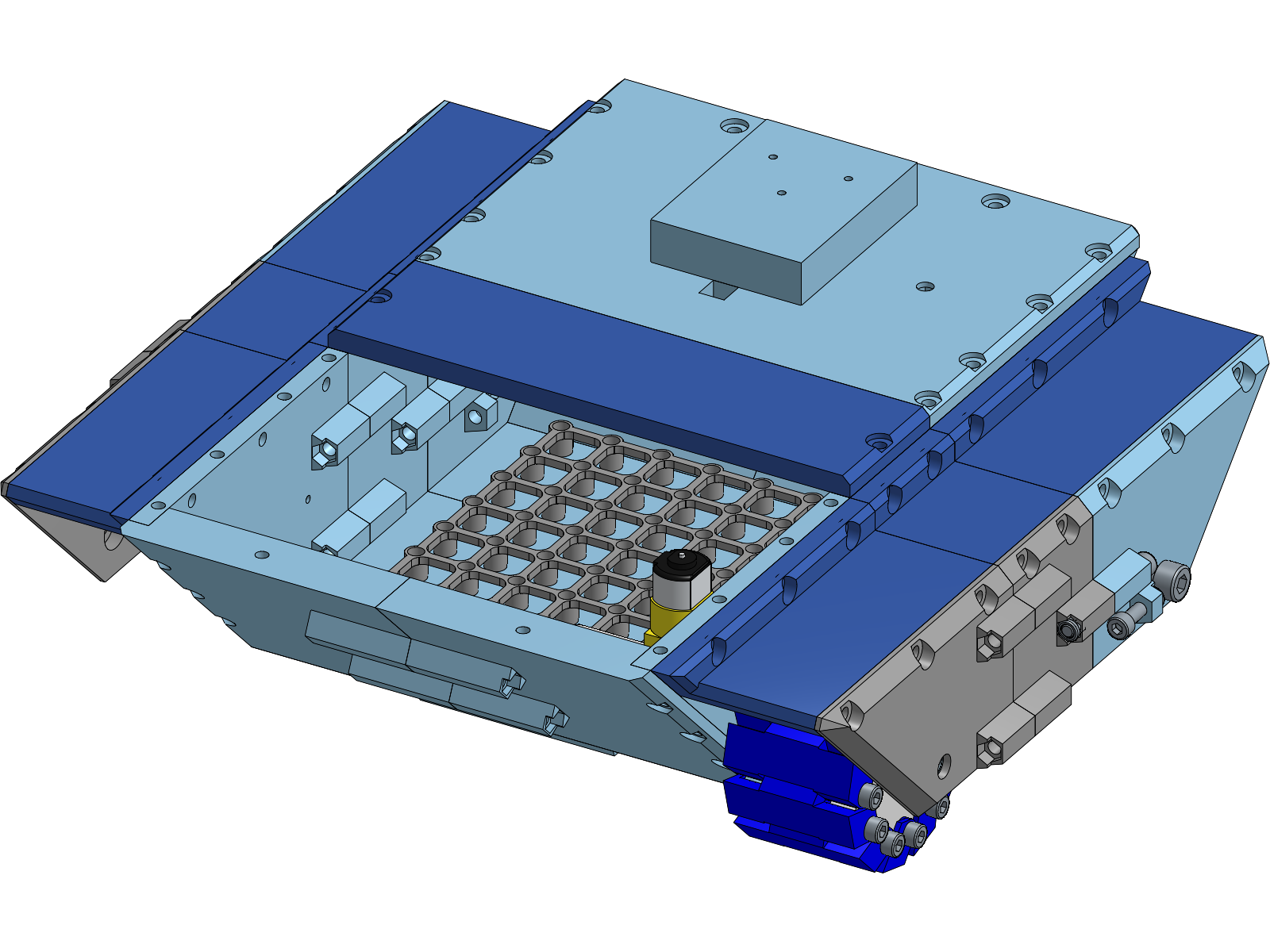
| Isometric | tank-assembly-isometric.png | Hero shot — long flat top plate, blue 3D-printed track on the left, segmented “modular” chassis sections, raised battery-holder block on top |
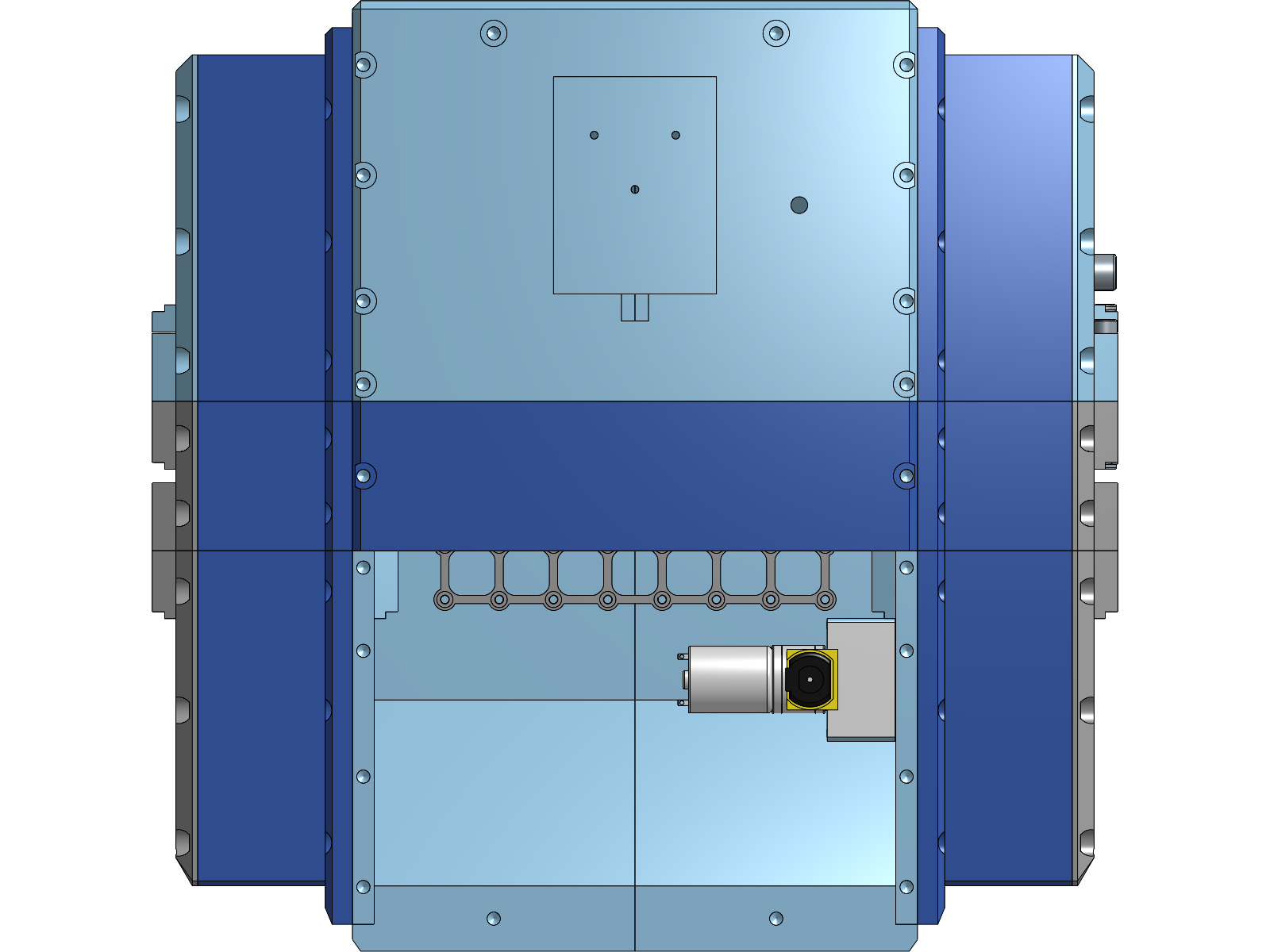
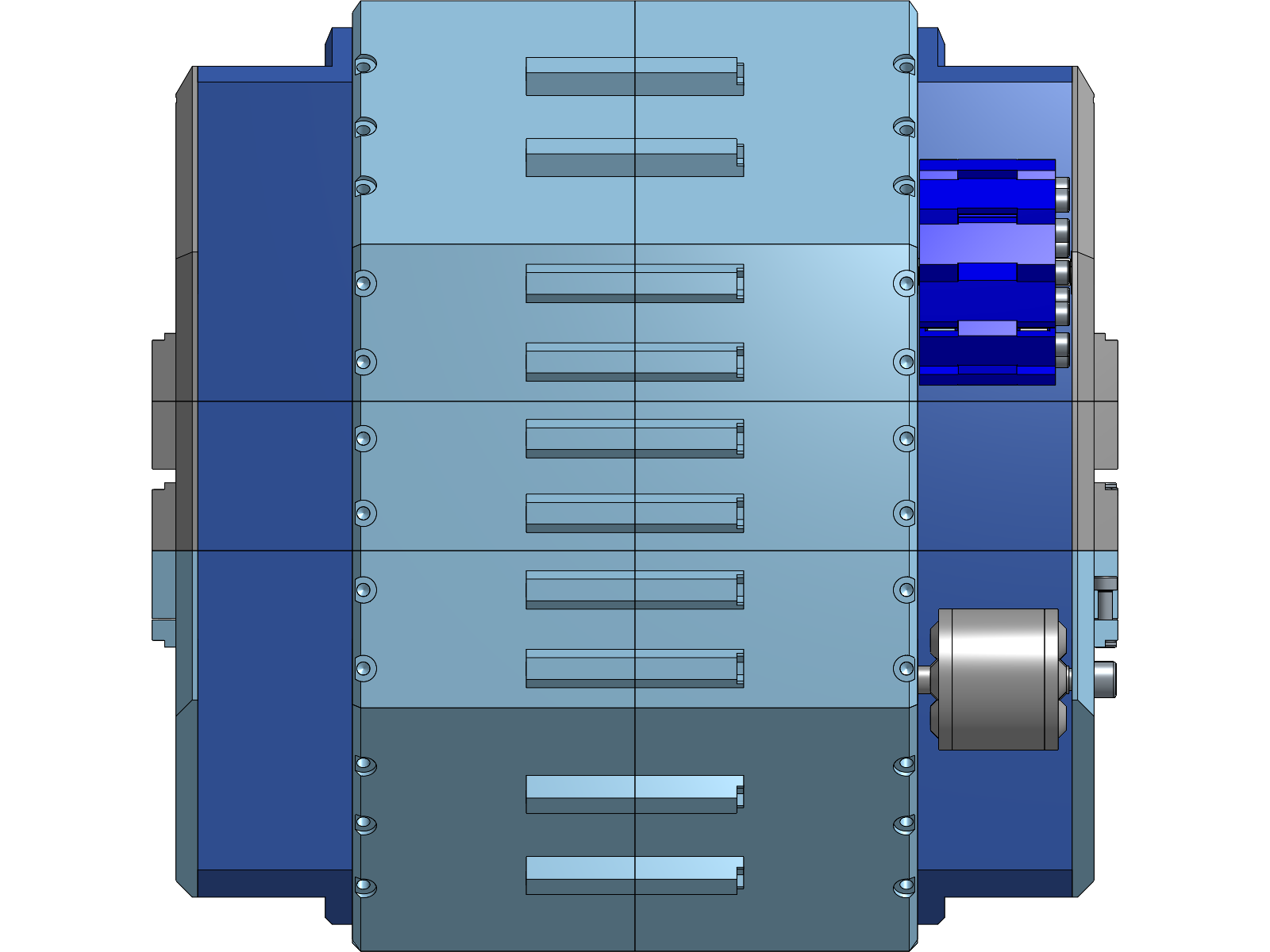
| Top | tank-assembly-top.png | Top-down: large flat top plate with battery-holder block centered, raised antenna boss on its top face, two flush slots through the deck, TT-gearbox motor visible at lower-right edge of frame |
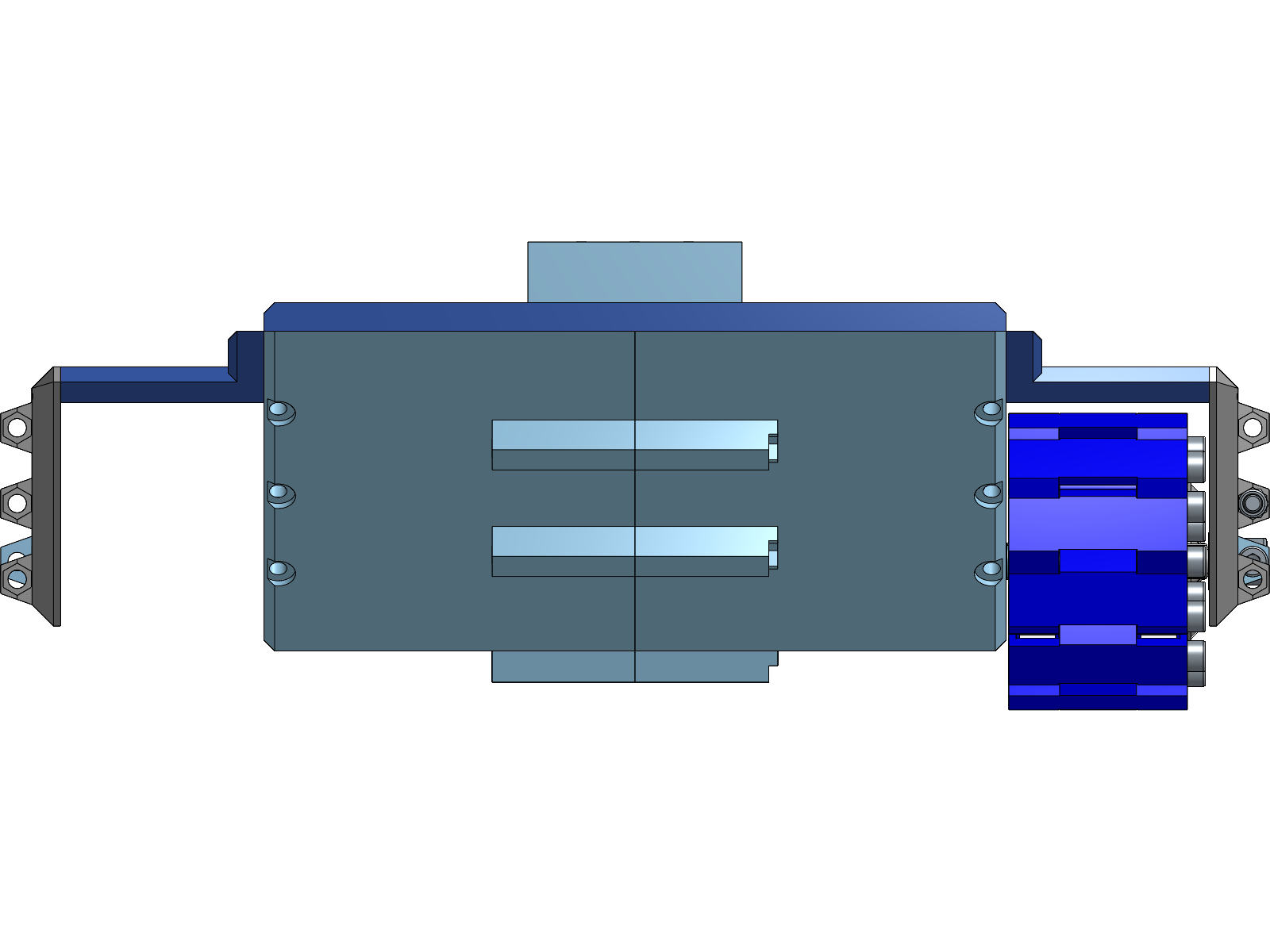
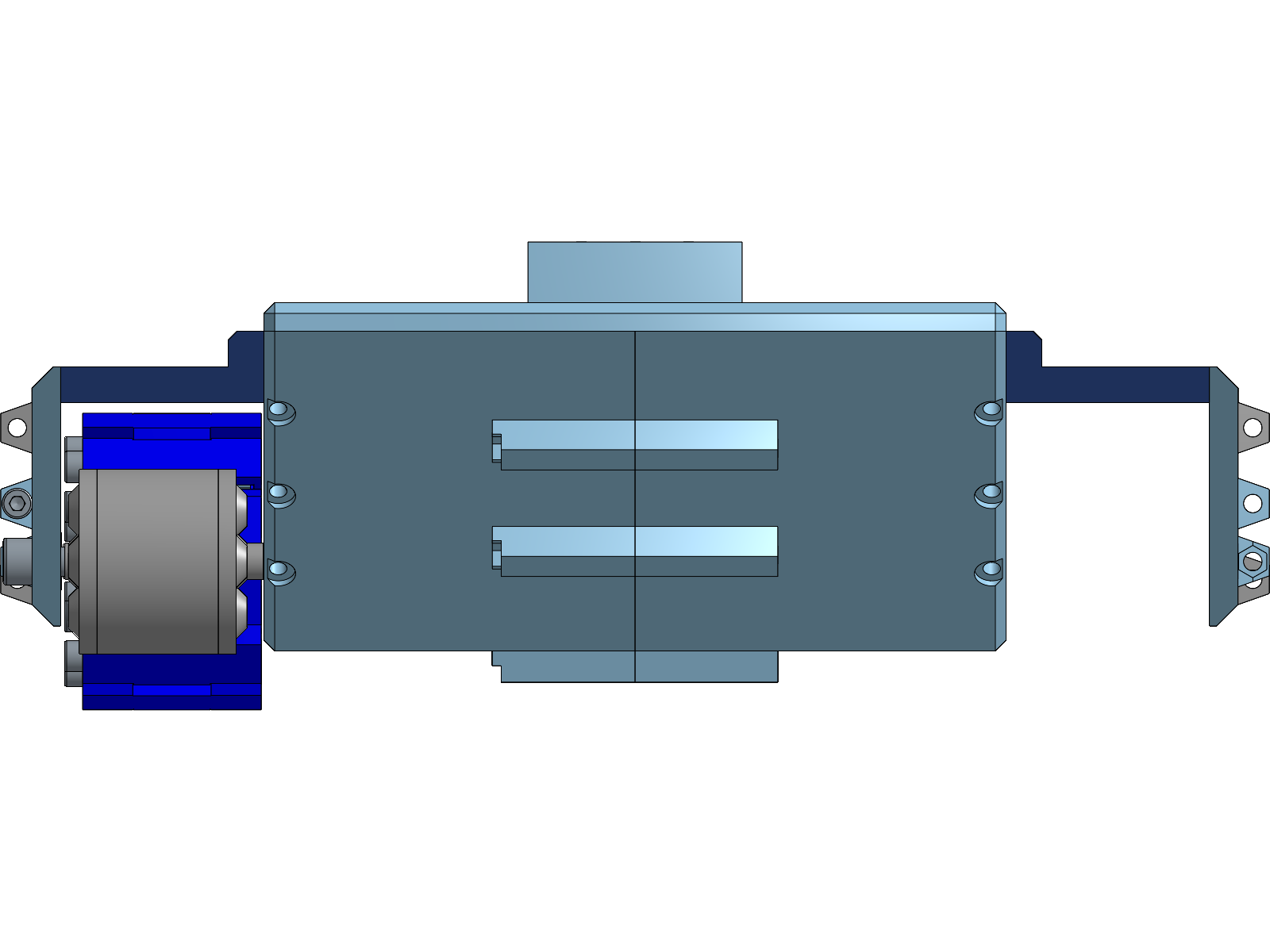
| Bottom | tank-assembly-bottom.png | Underside — chassis split into 5 transverse “ribs” / sections (each ~one body-extrude block wide), the blue track wraps around the right edge in this view, brushed motor body visible at far right |
| Front (CAD) | tank-assembly-front.png | End-on view with blue track + sprocket cluster at the right of frame, ground-clearance lugs on the left (the non-driven idler end), and the battery-holder block protruding up out of the top plate |
| Back (CAD) | tank-assembly-back.png | Mirror of front — sprocket cluster on the left, idler lugs on the right, brushless-style motor can visible below the deck on the sprocket side |
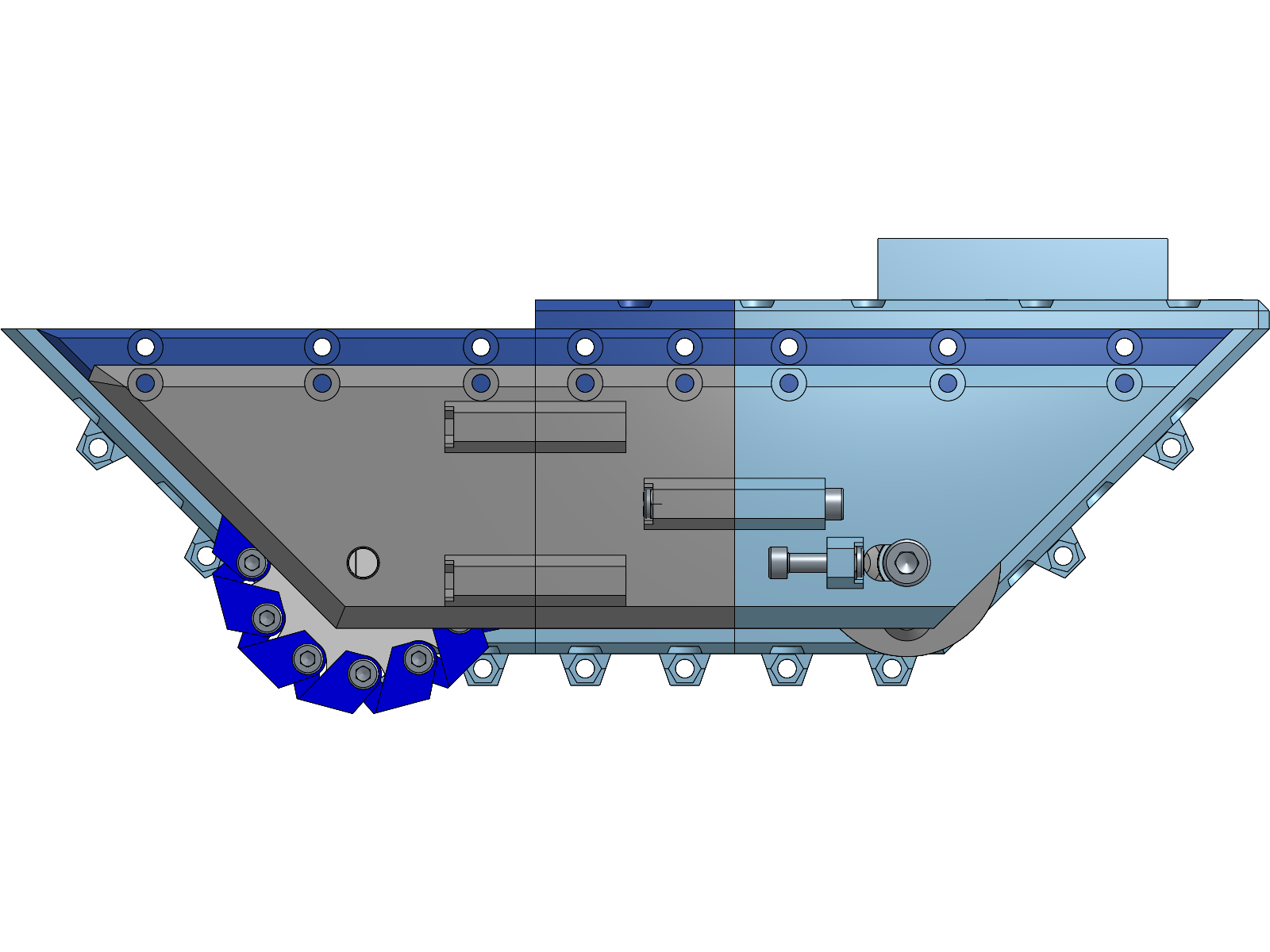
| Right (CAD) | tank-assembly-right.png | Side profile — wedge-shaped ends both front and rear, sprocket gear cluster at the left (combat front?), driven shaft pokes through the chassis side mid-height, six M5 cap heads visible along the deck edge |
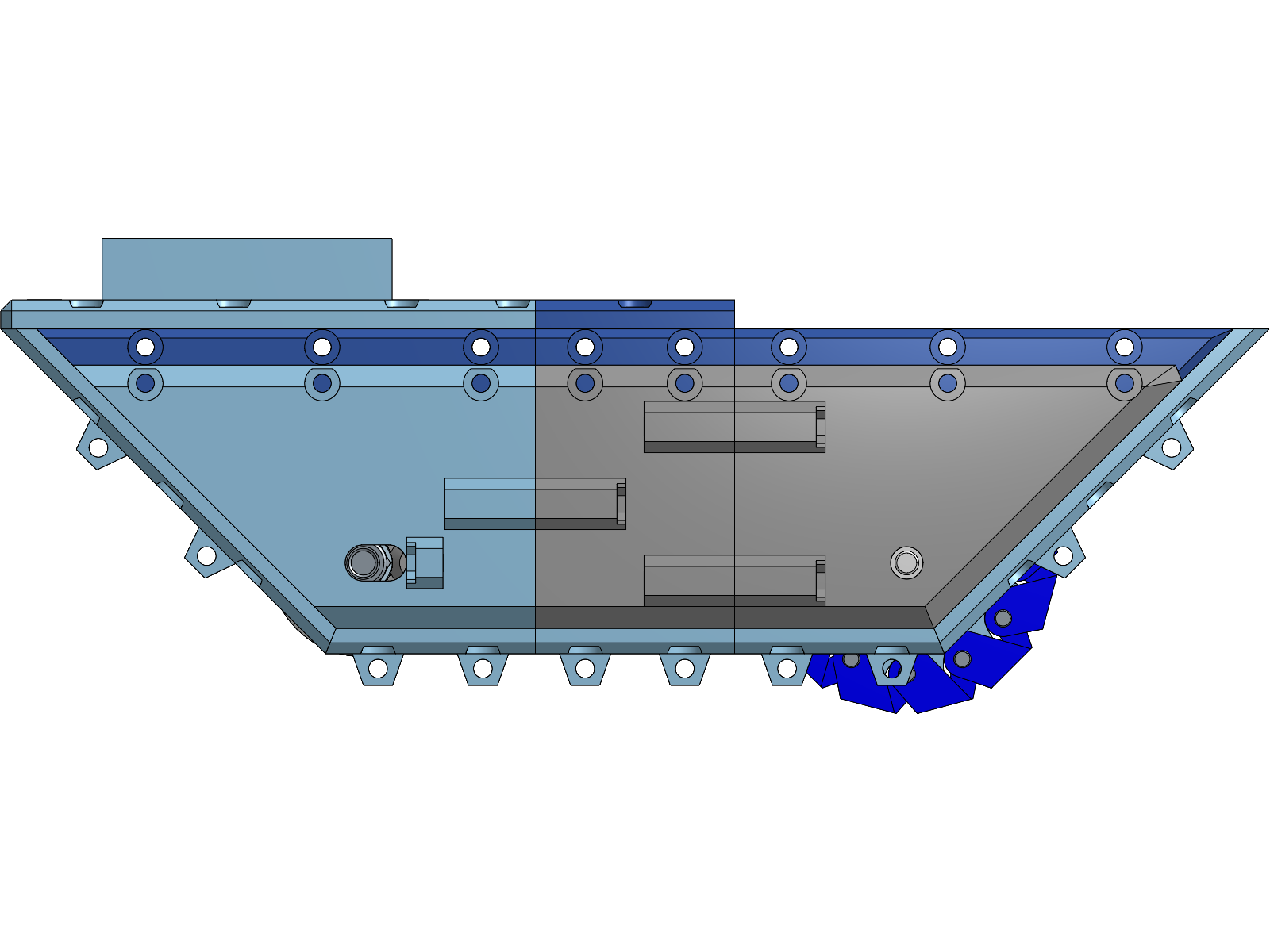
| Left (CAD) | tank-assembly-left.png | Side profile, opposite side — no sprocket visible (track loops behind the chassis); the non-driven side is mostly clean panels |
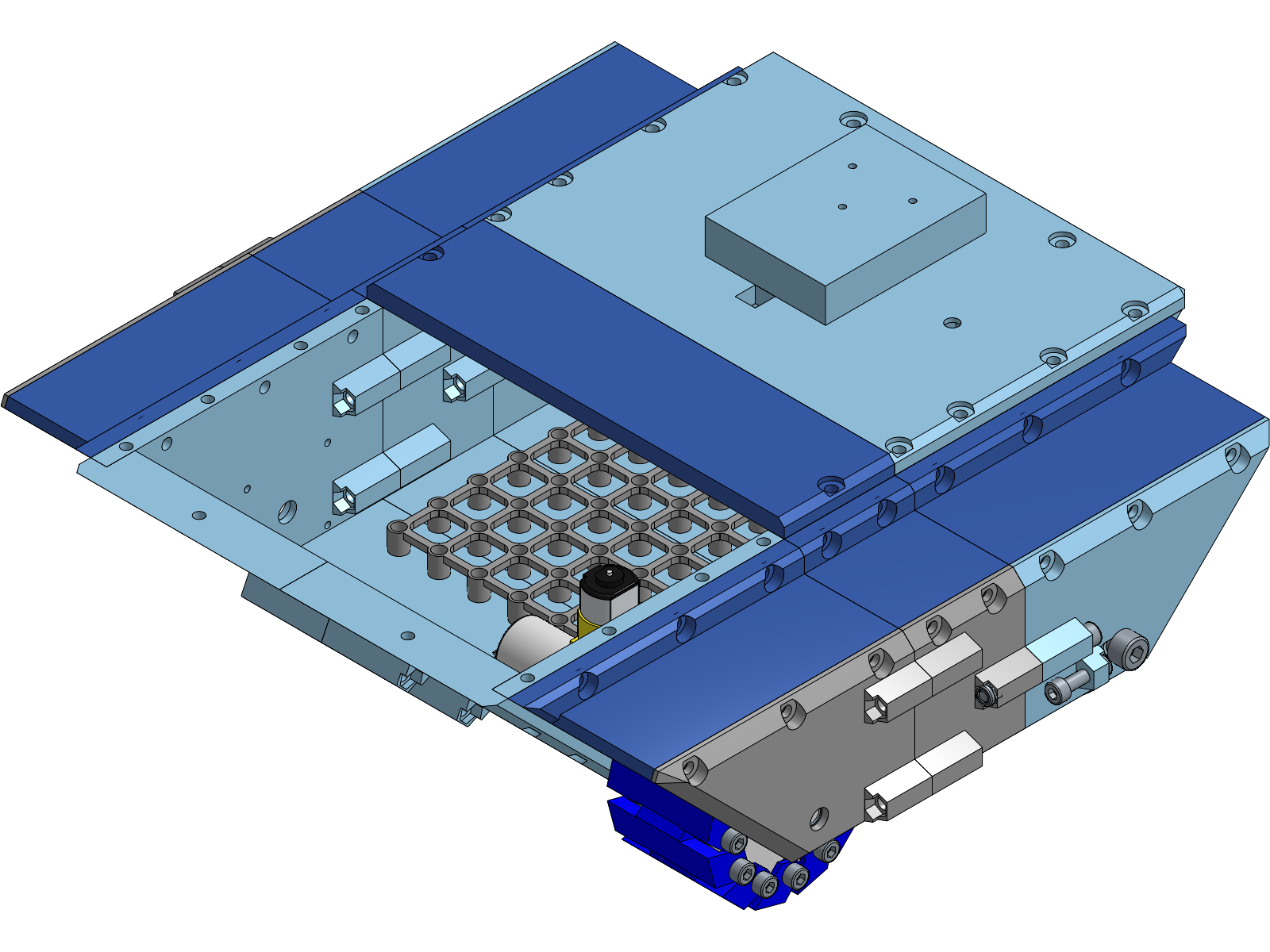
| Trimetric | tank-assembly-trimetric.png | Alternative iso angle, useful for showing the deck cutouts + track-side relationship together |