Overview
Chaos Thing started as Ricardo’s 6th birthday present — he’s obsessed with robots, and there are almost no combat-robot toys to be found in Europe, so we built him a real one. It’s the second Nerdy Layers beetleweight alongside C.I.C.D., and it’s his robot: Ricardo drives it.
A 1.5 kg beetleweight horizontal spinner with a wood-cutting saw blade bolted straight onto a brushless motor, riding on a fully TPU-printed body. It made its debut at Maker Faire Porto 2026 (18–20 September 2026) in Liga REC, where Ricardo won his first ever fight — a real match on the Friday, before the tournament began — and the robot went the distance in every match.
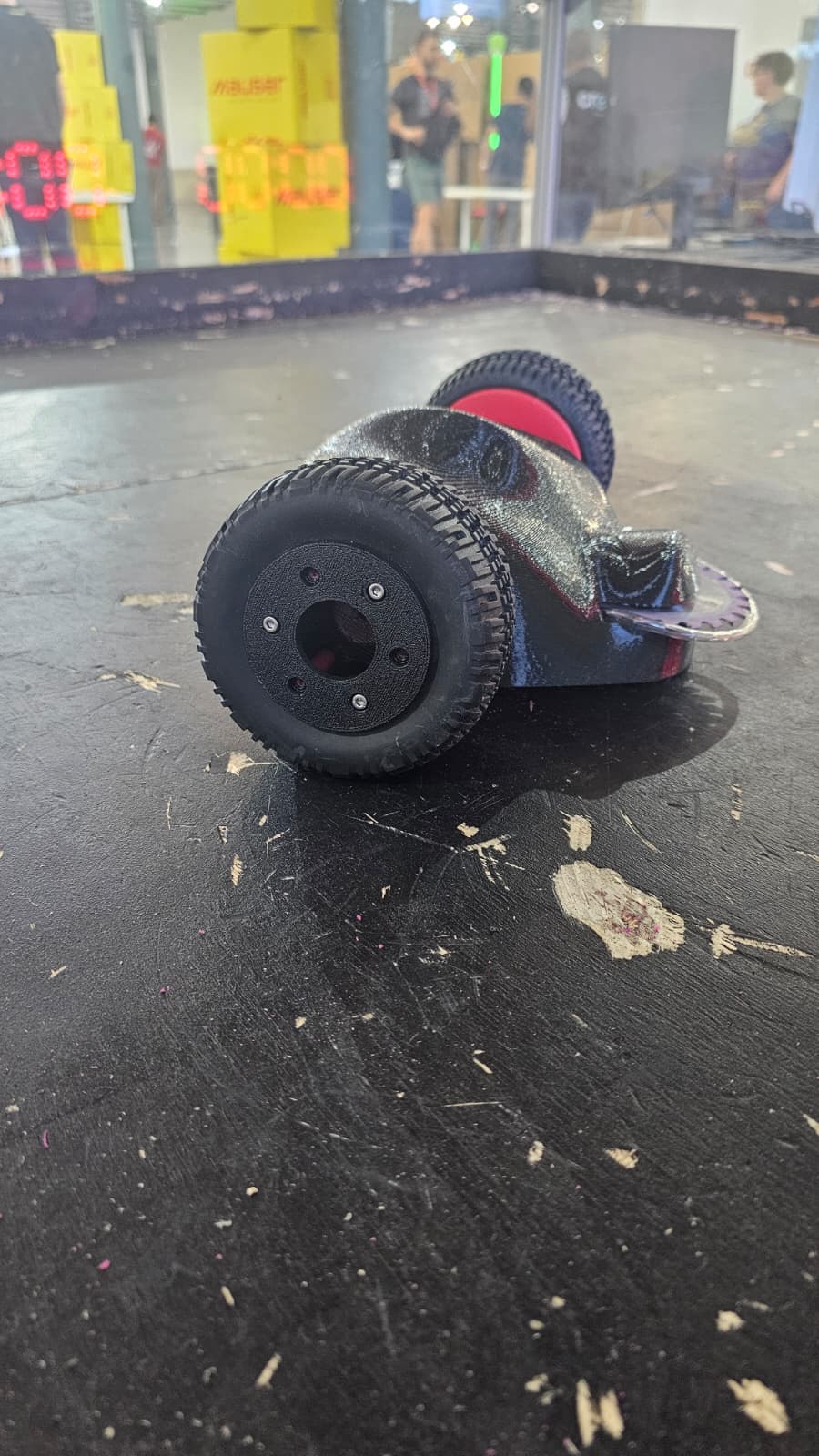 Chaos Thing in the arena at Maker Faire Porto — dark printed TPU body, large knobby tyres on five-bolt hubs with red inserts, and the wood-cutting blade at the front right. The wood shavings across the arena floor are its own work.
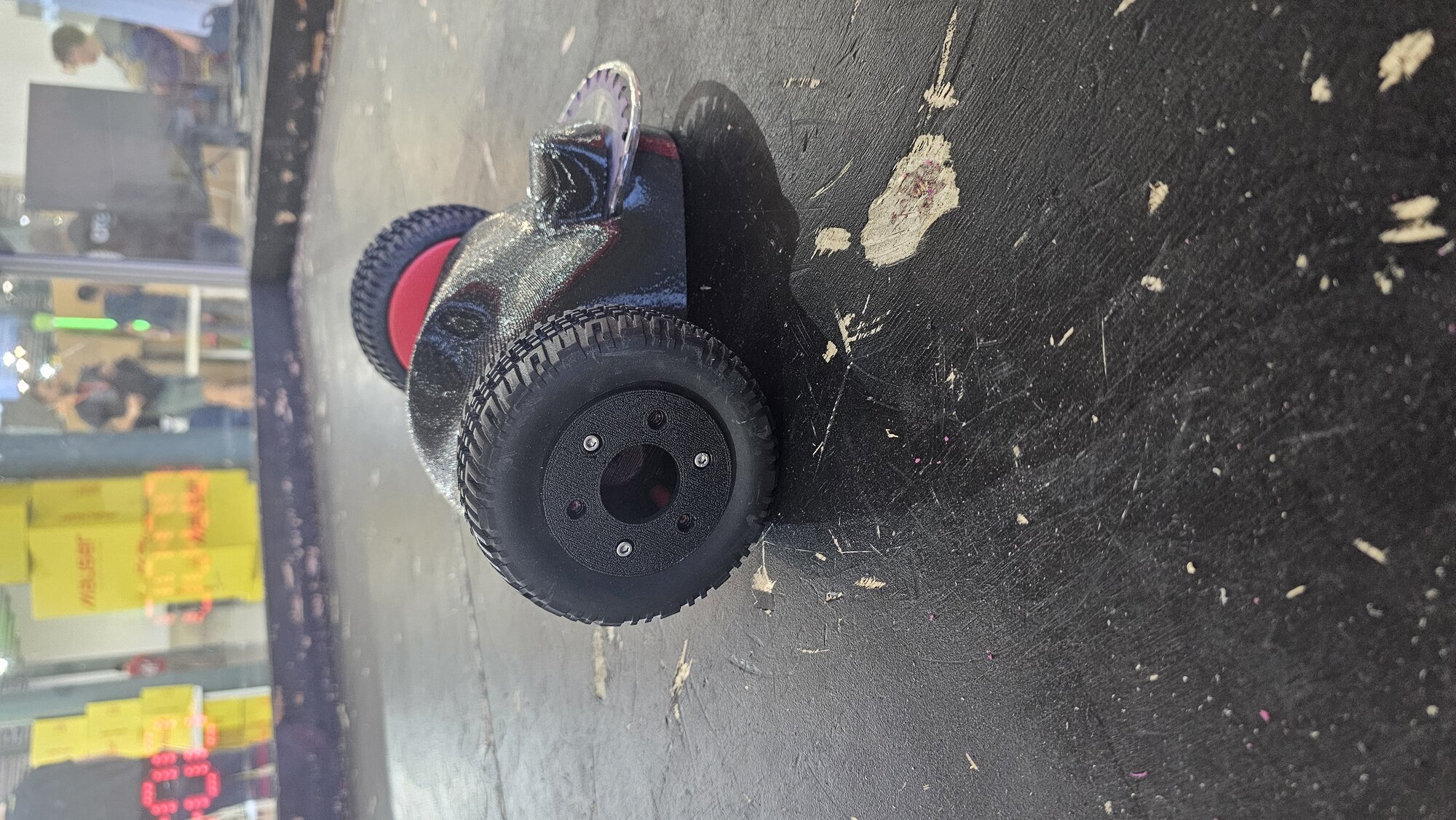 Low angle in the arena. The five-bolt hubs with red inserts and the deep knobby tread read clearly here, as does the circular blade projecting past the front right corner.
Related
Weapon
85 mm saw blade bolted straight onto an RS2205 — horizontal spinner, direct drive
An 85 mm, 1.6 mm-thick wood-cutting (circular-saw) blade mounted directly on the shaft of an RS2205 2300kv brushless motor, driven by a 50A AM32 ESC — the same weapon ESC as C.I.C.D.. No belt, no pulleys, no gearing: blade RPM is motor RPM.
The horizontal axis is the opposite of C.I.C.D.’s vertical spinner — it bites opponents side-on rather than throwing them upwards.
Direct drive cuts both ways:
- Simple and light. Nothing to derail, nothing to print, nothing to tune — very few parts to fail.
- No shock absorption. C.I.C.D. uses a friction belt that slips on impact; here every hit goes straight into the motor shaft and bearings.
The saw blade did serious damage at Porto. But woodworking blades aren’t built for steel-on-steel impacts, and at 1.6 mm thick they didn’t last. Tougher blades are the main upgrade for the next event.
Next blade: HSS — see HSS blade over a woodworking blade and Revisions.
Drive & Wheels
Brushed 2WD on 110 mm RC short-course wheels — forced by the transmitter
Chaos Thing uses brushed 2WD — two 25GA-370 12V 400RPM gearmotors driving 110 mm RC short-course wheels — rather than C.I.C.D.’s brushless 4WD. That was decided by Ricardo’s transmitter, not by preference (Brushed drive — forced by the T8L).
Ricardo’s Radiomaster T8L has no firmware mixing, so something else has to turn stick inputs into tank steering:
T8L can’t mix → the ESC has to mix → the ESCs that tank-mix on-board are brushed → the drive is brushed
Dual-channel brushed ESCs (like the KINGMODEL used here) commonly do tank mixing in hardware. Brushless ESCs are one-motor-per-board, made for aircraft, and expect the transmitter to do the mixing.
Brushed gearmotors are simpler, more forgiving and self-limiting — arguably the right call for a first robot and a new driver regardless. The real lock-in is the radio: brushless drive means changing the transmitter first.
Wheels
RC short-course (SCT 2.2/3.0) wheels — 110 mm diameter, 54.5 mm wide, knobby tyres on five-bolt hubs, mounted on the gearmotor shafts. The wheel-to-shaft attachment is the weak point to fix — see Revisions.
Chassis & Electronics
Fully TPU-printed body; the Lucille electronics stack with a mixing brushed ESC
Body — all TPU
The whole body is printed in TPU — no rigid frame, no metal armour. The bet was compliance over stiffness: TPU deforms under a hit and springs back, where a rigid printed body would crack.
Four fights at Porto, including one against the eventual champion, and the body kept going. For an all-flexible combat robot it’s a genuinely good result, and it’s the part of the build we’re keeping.
Electronics
Same proven stack as Lucille, which competed three times on it.
| Part | |
|---|---|
| Weapon motor | RS2205 2300kv, direct drive |
| Weapon ESC | 50A AM32 |
| Drive motors | 2× 25GA-370 12V 400RPM brushed gearmotors |
| Drive ESC | KINGMODEL dual brushed — 10A, 2S–3S, tank mixing on-board |
| Battery | 3S 850mAh CNHL MiniStar |
| Receiver | RadioMaster ER6, ELRS 2.4 GHz — PWM straight into the ESCs |
| Transmitter | Radiomaster T8L (ELRS) |
| Wheels | RC short-course (SCT 2.2/3.0) — 110 × 54.5 mm |
Revisions
Build versions and the status of every planned change
Each change moves through planned → designed → made → fitted → tested.
v1 — Porto build (current)
The build Ricardo drove at Maker Faire Porto 2026 (18–20 Sep 2026): all-TPU body, 85 × 1.6 mm woodworking saw blade direct on the RS2205, brushed 2WD on RC short-course wheels.
What Porto showed:
- The TPU body held up through four fights — keep it
- The saw blade hit hard but didn’t last
- The wheels’ attachment to the motor shafts needs to be stronger
- With the wheels mid-body, it can pitch back when charging and lift the blade off the floor
v2 — post-Porto (planned)
| Change | Why | Status |
|---|---|---|
| HSS saw blade | Teeth are part of the steel body — no carbide tips to snap off (HSS blade over a woodworking blade) | Planned — to source, ~85 mm, ideally thicker than 1.6 mm |
| Stronger wheel-to-shaft attachment | The weak link on the gearmotor shafts | Planned |
| Tail / rear foot | Keeps the nose — and the blade — low when charging in | Planned |
| Paint on the eyes | Before its next outing | Planned |
CAD
Onshape model with the shell on and off
Modelled in Onshape — open the CAD. With the shell off, the layout is simple: the 3S pack runs down the middle, a gearmotor on each side drives a wheel directly, the XT30 distribution board sits at the rear corner, and the RS2205 sits under the blade at the front.
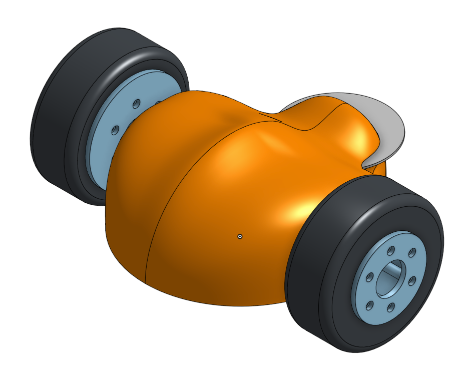 The full robot — one-piece rounded TPU shell, the saw blade peeking out of a notch at the front.
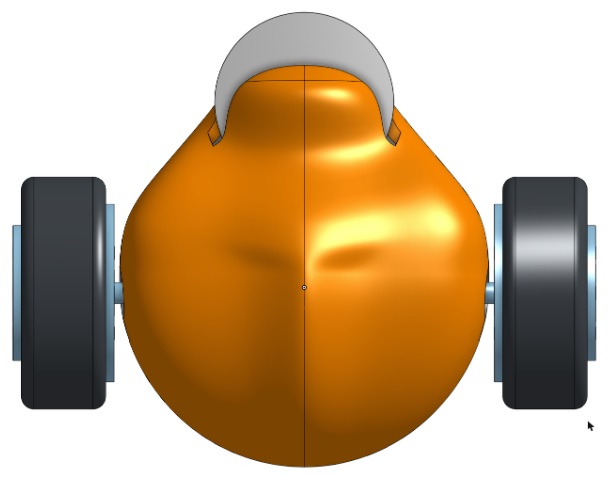 Top view. The shell is a teardrop that narrows towards the blade.
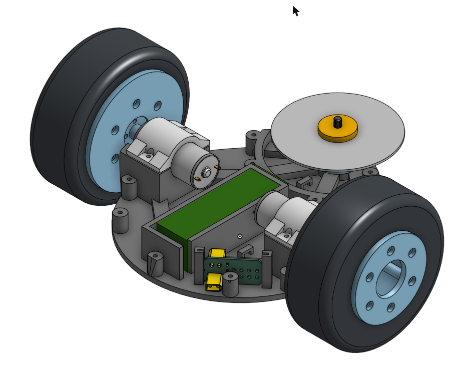 Shell off: printed base plate with standoffs, the two 25GA-370 gearmotors in clamp mounts, the battery in its centre bay, and the blade on the weapon motor up front.
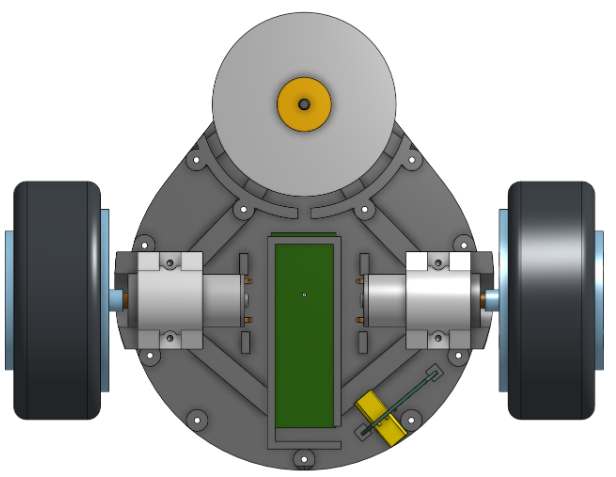 Shell off, from above. Battery bay in the centre, drive motors either side, XT30 distribution board bottom right, 85 mm blade at the top.
| From the CAD | |
|---|---|
| Blade | 85 mm diameter, 1.6 mm thick |
| Wheels | 110 mm diameter, 54.5 mm wide |
| Overall width | ~277 mm across the wheels |
Design decisions
What we chose, what we rejected, and why.
Brushed drive — forced by the T8L
accepted The Radiomaster T8L can't mix, so the ESC must — and the ESCs that tank-mix are brushed
Brushed drive — forced by the T8L
acceptedDecision: brushed 2WD with a mixing dual-channel ESC. Not chosen: brushless drive like C.I.C.D.’s.
Ricardo’s Radiomaster T8L has no firmware mixing, so something else has to turn stick inputs into tank steering:
T8L can’t mix → the ESC has to mix → the ESCs that tank-mix on-board are brushed → the drive is brushed
The options were:
- Brushed drive + mixing ESC ← chosen
- A transmitter that mixes (not the T8L)
- A separate mixer board between receiver and brushless ESCs — more parts, more to fail, more to wire
Brushed gearmotors are simpler, more forgiving and self-limiting — arguably the right call for a first robot and a new driver anyway.
Revisit if
Ricardo wants brushless drive — the transmitter has to change first.
HSS blade over a woodworking blade
accepted Next blade is solid high-speed steel — no brazed carbide tips to break off
HSS blade over a woodworking blade
acceptedDecision: replace the woodworking saw blade with an HSS (high-speed steel) blade, as recommended by Diogo from Woodpeckers. Rejected: carbide-tipped (TCT) blades.
The 85 mm × 1.6 mm woodworking blade did serious damage at Porto but didn’t survive. Carbide-tipped blades have brazed tips that snap off on impact. On an HSS blade the teeth are cut into the steel body itself, so there’s nothing to shed — they bend rather than break.
Target: around 85 mm, ideally thicker than the current 1.6 mm. Status in Revisions.
Competition log
-
Maker Faire Porto
1–3 overall (RR 1–1, bracket 0–2) — eliminated by Samurai, the event winnerevent2026-09-18 location_onAlfândega do PortoChaos Thing’s first event (18–20 September 2026), run by Liga REC, with Ricardo driving. Round robin, then a double-elimination bracket.
Ricardo won his first ever fight on the Friday, before the group phase — a real match, but outside the tournament, against wobbegong — the robot that went on to reach the Grand Final. In the tournament itself Chaos Thing went 1–3, and it finished every match it started.
Round robin
Opponent Result How wobbegong ❌ Loss jury Dummy ✅ Win jury Bracket
Round Opponent Result How Quarter-final 2 C.I.C.D. ❌ Loss jury Losers Round 1·A bye ✅ Advanced bye Losers Round 2·A Samurai ❌ Loss KO — eliminated Both bracket losses were to strong opposition: a jury decision against its stablemate C.I.C.D., and a KO from Samurai, the eventual champion.
Takeaways
The full-TPU body was very reliableFour fights, and the body shrugged them all off. TPU deforms and recovers where a rigid body would crack.
The saw blade hits hardSerious damage to opponents — the wood shavings on the arena floor were Chaos Thing’s.
Blades need to be tougherThey damaged well but didn’t survive well. More durable blades for the next event.